




When Is Hair Loss Worth Checking? 5 Signs to Watch
Hair thinning rarely happens overnight.
July 18, 2026

By Dr Chung
Beauty Inspire | IYAC Medspa
Many people assume hair loss begins when they can see their scalp.
In fact, by the time more scalp becomes visible, hair thinning has usually been developing for quite some time.
Long before the scalp shows through, hair follicles begin producing progressively finer and shorter hairs. The scalp still appears well covered, but the hair itself starts to change. It feels less full, holds less volume, becomes harder to style, and a ponytail no longer feels as thick as it once did.
Because these changes develop slowly, they are easy to dismiss as stress, ageing, hormonal changes, or simply “one of those things.”
Recognising these early changes is not about becoming anxious over every strand of hair that falls out. It is about recognising when your hair is behaving differently from what has always been normal for you.
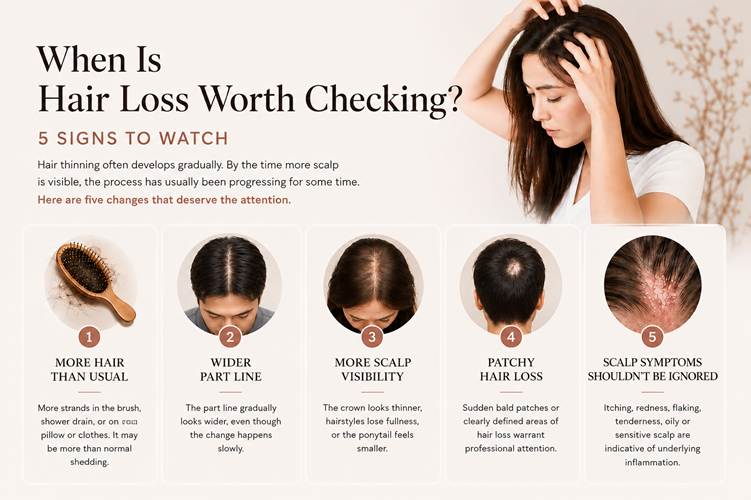
Here are five changes that deserve your attention:
More Hair Than Usual
Hair shedding is part of the normal hair growth cycle, so seeing a few hairs in the shower or on your hairbrush is expected.
The important question is not whether hair is shedding, but whether the amount has changed.
Most people instinctively know what is normal for their own hair. A hairbrush that fills more quickly than before, more strands collecting in the shower drain, or hair appearing more frequently on clothing and pillows are often the first clues that something has changed.
Increased shedding commonly follows physical illness, surgery, emotional stress, rapid weight loss, pregnancy, nutritional deficiencies, or prolonged poor sleep. As shedding frequently begins several weeks or months after the triggering event, the connection is easily overlooked.
When shedding becomes noticeably different from your usual pattern, it is worth understanding why.
Wider Part Line
For many, the mirror provides the first clue.
The hair is not necessarily falling out in large amounts. Instead, the part line gradually becomes wider.
Because the change is so subtle, it often goes unnoticed until older photographs reveal the difference. What once looked like a narrow parting now appears wider, even though the change has been taking place little by little over time.
A widening part line is one of the earliest and most recognisable signs that hair density is changing.
More Scalp Visibility
Hair thinning seldom begins with bald patches.
Instead, the crown looks a little thinner under bright lighting, hairstyles lose their fullness, or a ponytail feels smaller despite using the same hair tie.
These subtle differences reflect a gradual reduction in hair density. When the scalp becomes noticeably more visible, thinning has generally been progressing for some time.
Patchy Hair Loss
Patchy hair loss follows a different pattern from gradual thinning.
A sudden bald patch or a clearly defined area of hair loss should not be ignored. Unlike gradual thinning, patchy hair loss often reflects a different underlying process and should be properly assessed to determine the cause.
Rather than waiting to see whether it improves on its own, the priority is understanding why it developed.
Scalp Symptoms Shouldn’t Be Ignored
Hair and scalp health go hand in hand.
Persistent itching, redness, flaking, tenderness, excessive oiliness, or irritation usually reflects underlying scalp inflammation.
Inflammation disrupts the normal hair growth cycle, increases shedding, and affects the quality of new hair growth. Some people notice scalp symptoms before they notice visible thinning.
A healthy scalp provides the foundation for healthy hair growth. Persistent scalp symptoms, therefore, deserve the same attention as changes in the hair itself.
Why Early Assessment Matters
Hair thinning seldom has a single explanation.
Genetics, hormonal changes, nutritional deficiencies, stress, scalp inflammation, and age-related changes frequently overlap. Two people with similar-looking thinning can have very different contributing factors.
This is why understanding the cause is more important than guessing.
Tools such as the TrichoLAB Hair Scan provide an objective assessment of hair density, scalp condition, and hair growth patterns. Together with a clinical assessment, they help distinguish between stress-related shedding, nutritional influences, hormonal changes, scalp disorders, pattern hair loss, or a combination of contributing factors.
Earlier assessment provides a clearer understanding of what is driving the change and helps identify reversible factors before thinning becomes more advanced.
The Takeaway
Hair thinning rarely announces itself dramatically.
For most people, it begins with subtle changes that only become obvious in hindsight. The part line looks wider. The ponytail feels smaller. Styling takes more effort. The scalp feels itchy or irritated.
These are not changes to ignore, nor are they reasons to panic.
Hair thinning rarely happens overnight. Recognising the early signs is the first step towards understanding what your hair is telling you. Once the underlying cause is understood, the next steps become much clearer.
This article is intended for educational purposes only and should not be considered medical advice. Individual circumstances vary, and a consultation with a qualified hair professional is recommended for personalised assessment and advice.
On this page
Have Questions?
We are here to help!
Whether you’re ready to book a treatment, have a question about your skin, or simply want to learn more about how we can help you feel your best, we’d love to hear from you. At IYAC Medspa, we take a thoughtful, personalised approach to every client and are here to support you at every step. Please reach out via the form below or give us a call - our friendly team is happy to assist.